miércoles, 20 de noviembre de 2013

La sonrisa de un perro. The smile of a dog


Al cumplir los cuarenta, Julia abandona su trabajo como productora museográfica para convertirse en técnica de terapias asistidas con animales. En esta aventura la acompañan tres socios de cuatro patas: Milú, una fox terrier, y dos labradores, Thor y Volka.
Con ellos trabajará en hospitales, centros de salud mental, residencias de ancianos y prisiones. Habrá alegrías y emociones, pero también tristezas, desafíos e interrogantes. Las respuestas deberá buscarlas en su corazón y en la compañía de sus perros, cuya sonrisa es la mejor de las terapias.
At the age of forty, Julia leaves her work as museographic producer to become animal-assisted therapy expert. In this adventure, she´ll be acompanied by three four-legged partners, Milu, a fox terrier, and two laborers, Thor, and Volka. With them, she will work in hospitals, mental health centres, nursing homes and prisons. There will be joy and emotions, but also sadness, challenges and questions. She should seek the answers in his heart and in the company of their dogs, whose smile is the best of the therapies.


Y aquí las dos autoras con los protagonistas caninos de la historia y el día de la presentación del libro.

This is a photo of the two authors with the canine protagonists of the story and some of the day of the presentation of the book.


 Fotos: www.facebook.com/La-Sonrisa-De-Un-Perro                                                                     


martes, 19 de noviembre de 2013

12 Consejos para elegir la comida de tu perro. 12 Tips for choosing your dog´s food


Una de las cosas más importantes de decidir cuando tenemos un perro es su alimentación. Lo primero que debemos decidir es si le vamos a dar comida casera o preparada. Y si nos decidimos por pienso, llegamos a la tienda y nos encontramos con tantas variedades de comida para perro que no sabemos que elegir.


1. Mucha gente, por cariño,  piensa que  hacerle la comida al perro es lo mejor pero muchas veces, si no está correctamente preparada, no se cubren todas sus necesidades nutricionales y no le ofrecemos los nutrientes necesarios para su crecimiento, desarrollo y mantenimiento de su sistema inmunitario, protección de su aparato digestivo, desarrollo de su sistema esquelético y muscular, necesidades energéticas, prevención del envejecimiento... Es decir le quitamos el hambre, pero no le damos lo necesario para mantener su salud y peso ideal.
El pienso y otros productos elaborados para nuestros perros cumplen una serie de requisitos, son dietas equilibradas, ofrecen todas las proteínas y demás componentes necesarios para su desarrollo y ayudan a la prevención del sarro, es decir, son alimentos elaborados específicamente para cubrir sus necesidades. Además, los piensos provocan menos gases en el perro que la comida casera. Y como el objetivo principal es que nuestra mascota esté bien alimentada, la elección de un buena comida para perro será lo mejor para ella.


2. Lo primero que hay que hacer es elegir un pienso de calidad y que nos ofrezca confianza. Existen muchas marcas pero no todas son igual de fiables. Recordemos el escándalo de los piensos elaborados con  perros abandonados y enfermos. Invertir en un buen pienso significa salud para nuestra mascota y aumentar su esperanza de vida. Los piensos de gamas altas están hechos con ingredientes de gran calidad.


3. Ten en cuenta que le debe gustar a tu perro. Influirá la textura, el olor, la dureza y por supuesto el gusto de tu perro.


4. Elige un pienso adecuado al tamaño de tu perro. No va a tener la mismas necesidades un Chihuahua o un Yorkshire que un  San Bernardo o un Dogo. El tamaño de las bolas o croquetas del pienso no será igual para la mandíbula de un Ratón de Praga que de un Pit Bull.


5. Elige un pienso adecuado a la edad de tu perro. Las necesidades nutricionales no son las mismas si tu perro es cachorro o es anciano. Además si es joven y enérgico un pienso mas duro ayudará a mantener sus dientes y encías en perfecto estado pero si es muy joven o muy mayor necesitará un pienso mas blando y fácil de masticar.


6. Elige un pienso adecuado a la actividad de tu perro. Si tu perro es muy activo necesitará un alimento más calórico pero si por el contrario es un perro sedentario o casero necesitará un pienso más específico para que no engorde (light).


7. Si tu perro está esterilizado hay que elegir un pienso que le ayude a mantener el peso, ya que después de la operación existe una tendencia a engordar. Hay piensos preparados que tienen una mayor proporción de proteínas y mas bajo en grasas, ademas de elementos saciantes para disminuir la sensación de hambre. Esto y un aumento de la actividad le ayudará a mantenerse en su peso ideal.


8. Existen alimentos para cubrir etapas especiales como la gestación o la lactancia. Hay leches para cachorros que no pueden ser dados de alimentar por su madre que tienen una formulación muy parecida a la de la perra. un cachorro no puede ser alimentado con leche de vaca porque le provocará problemas digestivos y de intolerancia

9. En el caso de que tu perro tenga un problema, por ejemplo de digestión, corazón o riñón, los piensos especiales van a ayudar a que su órgano dañado trabaje mejor y no se sobrecargue.


10. Para problemas de alergia o intolerancia habrá que elegir un pienso que no lleve en su elaboración el alérgeno. Por ejemplo si es alérgico al pollo habrá que elegir un pienso que lleve en su formulación cordero o buey.


11. Si tu perro tiene problemas de piel o pelo, dermatitis, picores, caspa...existen fórmulas especiales con ácidos grasos que ayudan a mejorar los síntomas y corregir el problema.


12. No mezcles pienso con comida casera. Elegirá la que mas le guste (generalmente la casera) y será difícil que acepte la otra. No le des sobras o picoteo de tu comida, porque engordará y se volverá más caprichoso. Recuerda que hay alimentos prohibidos para tu perro como las cebollas, las uvas o el chocolate.


Para Woody que sólo tiene 6 meses hemos elegido desde el principio un pienso de gran calidad para cachorros hasta 10 meses (Junior) de la gama de alimento Royal Canin para perros Mini y que no sólo le encanta sino que le sienta fenomenal. Y a las pruebas me remito:


One of the most important things to decide whenwe have a dog is its power. The first thing we must decide is if we're going togive homemade or prepared food. And if we decided for feed, arrived at thestore, and we have so many varieties of food for dog that we do not know which to choose.


1. Many people, for love, think that cook thedog´s food is the best for them but many times, if it is not properly prepared,all their nutritional needs are not covered, and we do not offer the nutrientsnecessary for growth, development and maintenance of their immune system,protection of their digestive system, development of their skeletal andmuscular system, energy requirements, prevention of aging...I.e. we remove thehunger, but we don't give them enough to maintain their health and idealweight.
Feed and other processed products for our dogsmeet a series of requirements, are balanced diets, offer all the proteins andother components necessary for their development and help the prevention of dentalplaque, i.e., food made specifically for their needs. In addition, feed causeless gas in the dog than home cooking. As the main objective is that our mascotis well nourished, the choice of a good quality dog food will be the best forhim.
2. The first thing to do is to choose a qualityfeed and offering us confidence. There are many brands, but not all are equallyreliable. Remember the scandal of animal feed made from abandoned dogs and sick. Invest in a good feed means for our pet health and increase theirlife expectancy. Feed of high ranges are made with high quality ingredients.
3. Keep in mind that your dog must like thefood. Influence the texture, the smell, the hardness and of course the taste ofyour dog.


4. Select a feed appropiated to the size of yourdog. A Chihuahua or a Yorkshire will not have the same needs  than a St. Bernard or a Doge. The size ofballs or croquettes  will not be equal tothe jaw of a Prague Mouse that of a Pit Bull.


5. Choose a suitable feed for the age of yourdog. Nutritional needs are not the same if your dog is a puppy or elder. If thedog is young and energetic a harder feed will help to keep his teeth and gumsin good condition but if he is very young or very old will need a softer andeasier feed to chew.
6. Choose a feed suitable to the activity ofyour dog. If your dog is very active will need a more caloric food, but if onthe contrary is a sedentary or home dog, he will need a more specific feed inorder to not fattening (light).
7. If your dog is sterilized you should choosea feed that will help him to maintain the weight after the operation, becausethere is a tendency to gain weight. There are animal feed preparations thathave a higher proportion of protein and lower in fat, in addition to satietyelements to reduce the feeling of hunger. An increase in the activity will helpto maintain his ideal weight.
8. There are food for stages such as pregnancyor lactation. You can find milk for puppies which cannot be  breastfed by their mothers which has a formulation very similar to the mother´s. Apuppy can not be fed with cow's milk because it will cause digestive andintolerance problems.
9. In the event that your dog has a problem,for example  digestion, heart, or kidneydisease, special feed will help the damaged organ to work better and not to beoverload.
10. For problems of allergy or intolerance youwill have to choose a feed that does not use in its elaboration the allergen.For example if the dog is allergic to chicken, must choose a feed that uses inits formulation, lamb or beef.
11. If your dog has skin or hair problems,dermatitis, itching, dandruff... There are special formulas with fatty acidsthat help to improve the symptoms and correct the problem.
12. Do not mix feed with home-cooked food. yourdog will choose the one he likes (usually the homemade) and will be difficultto accept the other. Do not give you leftovers or snacking from your food,because he´ll fatten and become more whimsical. Remember that there is food forbiddenfor your dog such as onions, grapes and chocolate.

For Woody, that  is 6 months old, we have chosen a high quality feed for puppies up to 10 months old (Junior) of Royal Canin for Mini dogs and he really loves it. You can see it in the pictures:


Fotos: Ohqueperro!


lunes, 18 de noviembre de 2013

Perros discapacitados. Disabled dogs


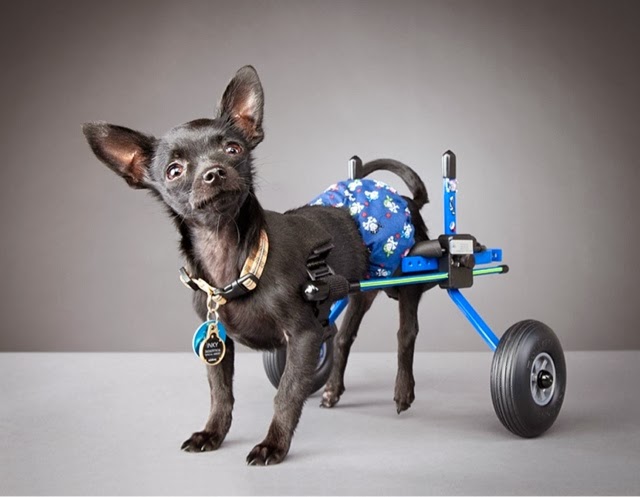
Cuando un perro sufre un accidente, una enfermedad o incluso un maltrato, que les provoca una incapacidad, suelen adaptarse rápidamente a la nueva situación. No pasan por un periodo de depresión por la pérdida como les ocurre a las personas sino que de forma asombrosamente rápida aprenden a manejarse con su nueva situación. Es una cuestión de supervivencia.
Generalmente se produce un daño neurológico, bien por traumatismo, bien degenerativo, que conduce a la pérdida del control de las patas traseras e incluso del control de esfínteres por lo que necesitarán ayuda para realizar sus necesidades.
Los dueños de perros que pasan por esto hacen todo lo posible para ayudarles y para que la adaptación de su querida mascota sea más fácil y cómoda. Para esta situación se han desarrollado unas ruedas que permiten sujetar el peso de las patas y que les ayuda a desplazarse con más comodidad y con menos lesiones, ya que al arrastrar las patas traseras se producen heridas por el rozamiento. También hay unas correas que permiten ayudar al perro a sujetar el peso de sus patas traseras.
 A pesar de que ver un perrito discapacitado suele provocar ternura y lástima, lo que deberiamos sentir es admiración por la entereza con la que asimilan su nuevo estado y por su capacidad de adaptación y superación.


When a dog suffers an accident, disease or even a mistreatment, which provoked a disability, tend to quickly adapt to the new situation. They do not pass through a period of depression for the loss as people but  surprisingly quickly they learn to manage with their new situation. It is a question of survival.
Usually when a neurological damage occurs, because of a degenerative problem or  trauma damage, which leads to the loss of control of the back legs and even the sphincters control, they will need much help.
The owners of dogs that pass through this do everything possible to help the dog and try to do the adaptation of their beloved pets easier and more comfortable. For this situation some special wheels have been developed  that allow the dog to fasten the weight of the legs and helps them to move more comfortably and with less injuries, since dragging back legs, injuries are caused by friction. There are straps that allow the owner to help the dog to hold the weight of their hind legs.
To see a disabled dog tends to cause tenderness and pity, but what we should feel  is admiration for the fortitude with which they assimilate its new status and its capacity of adaptation and improvement.


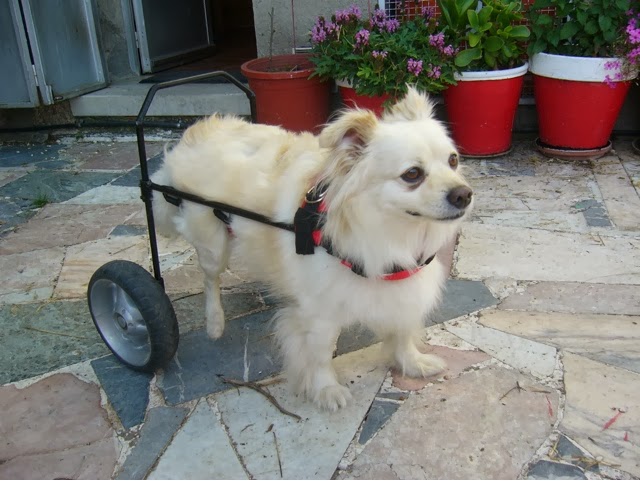
Y este es Sombra, el perrito de mi amiga Mª Luz. Sombra tuvo un problema neurológico del que tuvo que ser intervenido quirúrgicamente, pero desgraciadamente la operación no obtuvo el resultado deseado y a pesar de la rehabilitación y los masajes, no pudo recuperarse y mover las patas traseras. Para ayudarle decidieron hacerle un "carrito" para favorecer la movilidad. Por casa no le gustaba utilizarlo pero por la calle no le quedaba más remedio porque si no se provocaba heridas, a pesar que para prevenir daños Mª Luz le vendaba las patitas.

And this one is Sombra, the little dog of my friend M ª Luz. Sombra had a neurological problem of which he had to be controlled surgically, but unfortunately the operation did not obtain the wished result and in spite of the rehabilitation and the massages, could not recover and move the back legs. To help him they decided to do a "cart"  to favor the mobility. At home he did not like to use it but in the street he  had necessarily to use it because to drag the legs could cause wounds, even though M ª Luz used to bandage the legs to him.


domingo, 17 de noviembre de 2013

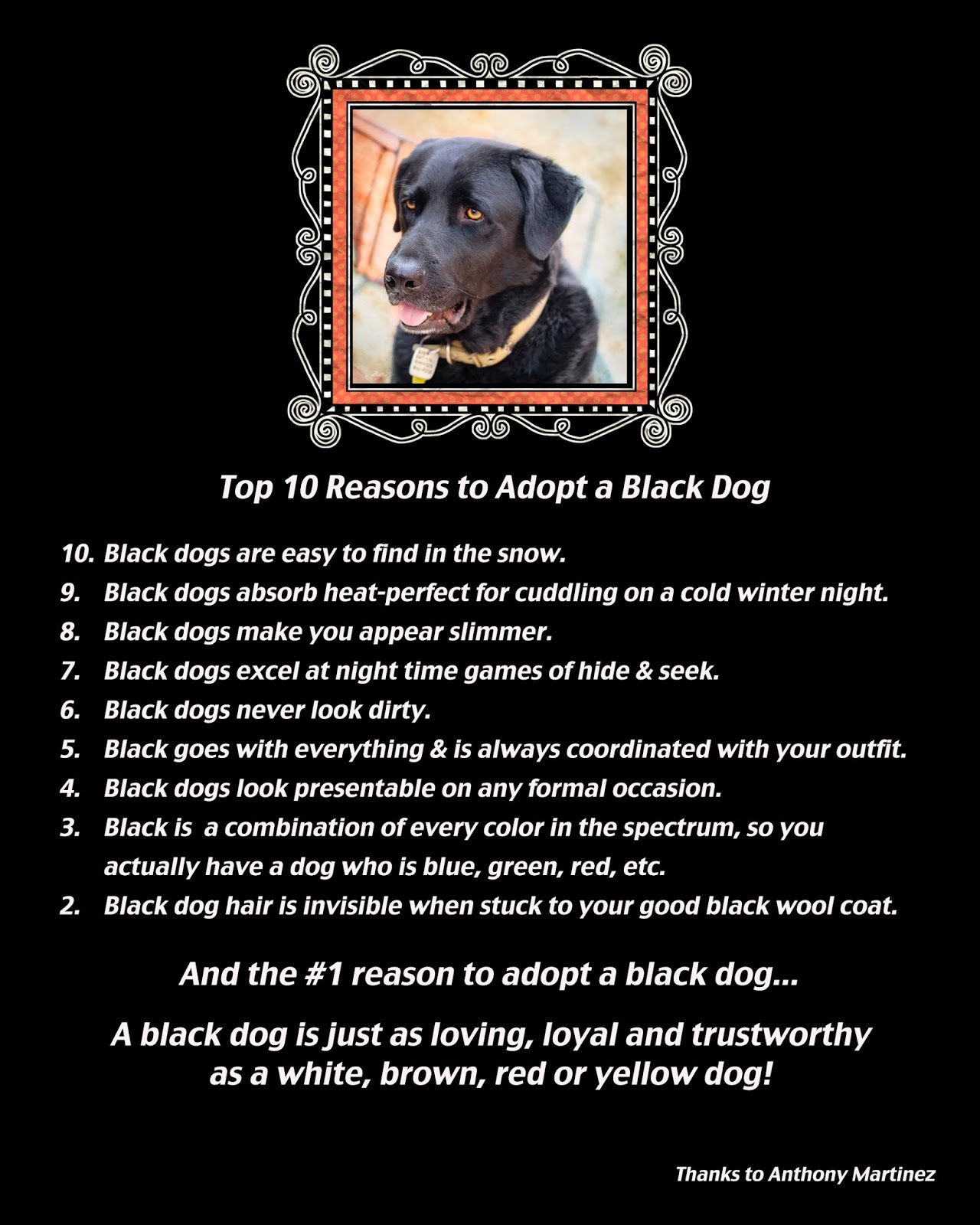
Síndrome del Perro Negro. Black Dog Syndrome


Cuando pensamos en adoptar un perrito tenemos en mente una serie de características que deseamos que el perro posea, como el tamaño, la edad, el carácter... Y ¿el color? Parece que eso no es algo relevante a la hora de decidirnos. Pero sí, los perros y gatos negros tienen menos posibilidades de ser adoptados que uno de cualquier otro color. Y si ademas de negro es grande, las posibilidades de ser adoptado son mínimas. Esto es lo que se conoce como el "Síndrome del Perro Negro".
No existe una causa por la que se pueda explicar este triste fenómeno que ocurre en todas las protectoras, refugios y asociaciones, pero existen una serie de motivos que podrían explicarlo.

.

1. Cultural e históricamente se ha asociado la maldad a los perros negros. Antiguamente se asociaba el perro negro al demonio y a la muerte y en la actualidad si se quiere representar a un perro peligroso y amenazador, en el cine o la televisión, se utiliza a un perro negro.
Como esto se repite continuamente la asociación perro negro=perro malo queda grabada en nuestro subconsciente. Busca "perro negro" en la Wikipedia y verás lo que pasa.
2. Es difícil fotografiar a un perro negro y captar su expresividad. Si la selección del perro a adoptar se hace a través de fotos o por la web, la posibilidad de que sea elegido es casi nula. Ademas es difícil ver un anuncio o campaña publicitaria con un perro negro como protagonista.
3. Si además tiene los ojos oscuros resulta mucho más difícil captar su expresión facial, lo que hace más difícil conectar emocionalmente con él durante la visita a la protectora. Además si se coloca a un perro negro con uno claro, la atención se dirige siempre hacia el perro de color más claro.
4. Los dientes de los perros negros se ven mas blancos sobre su pelo negro por lo que pueden parecer más amenazadores que otros perros más claros.
 La superstición es otra causa. Los gatos negros siempre se han asociado a  la mala suerte.
5. En algunas culturas se denomina a la depresión "Perro Negro".

The Black Dog Syndrome and Pet Adoption Issues

Es triste saber que un perro no va a ser adoptado, no por un problema de salud, o por su carácter  sino por el color de su pelo. Pero el color del pelo del perro no influye en el carácter, la salud o la personalidad del perro. Un perro negro es igual de expresivo, cariñoso, juguetón, mimoso, fiel y divertido que cualquier perro de otro color. Un perro negro es exactamente igual a otro de cualquier color, por eso, si tienes pensado adoptar un perrito, ten en cuenta el “Síndrome del perro negro” y no pases por alto a estos maravillosos perros negros. 


Las fundaciones, albergues y refugios conocen bien este problema e intentan promocionar a sus perros negros colocándoles pañuelos de colores, situándoles en las primeras jaulas, evitando poner varios perros negros juntos, para resaltar sus personalidades individuales, cuidando sus fotografías en sus páginas webs e, incluso, abaratando las cuotas de adopción.
Intentemos que todo el mundo conozca este problema y ayudemos  a perros y gatos negros a encontrar un hogar, dándoles una oportunidad.


When we think of adopting a dog we have in mind a series of characteristics that we wish that the dog owns, as the size, the age, the personality... And the color? It seems that it is not anything relevant at the moment of deciding. But it is, the black dogs and black cats have fewer possibilities of being adopted that one of any another color. And if besides black it is big, the possibilities of being adopted are minimal. This is what is known as the Black Dog Syndrome. There does not exist a reason for which it could explain this sad phenomenon that happens in all the protective ones, refuges and associations, but there exist a series of motives that might explain it.


1. Cultural and historically the evilness has been associated with the black dogs. Formerly the black dog was associated with the demon and with the death and at present if  a dangerous and menacing dog wants to be represented  , in the cinema or the television, a black dog is used. Constantly is repited the association black dog = bad dog and thid remains recorded in our subconscious. Look for " black dog " in the Wikipedia and you will see what happens. 
2. It is difficult to photograph a black dog and to catch his expressiveness. Their features do not show up well. If the selection of the dog to  be adopted is done through photos or for the web, the possibility that a black dog is chosen is almost void. In addition it is difficult to see an advertisement or advertising campaign with a black dog as protagonist.
3. And if the dog also has dark eyes it turns out much more difficult to catch his facial expression, which makes more difficult to connect emotionally with him during the visit to the animal shelter. In addition if a black dog is placed by the side of a clear one, the attention goes always towards the clearest dog. 
4. The  teeth on a black dog look whiter against his black coat and can look more menacing than clearest dogs.

.

5. Superstition is another reason. Black cats have been always associated with the superstition of bad luck.
6. Depression is referred to as the Black Dog in many countries.

It´s sad to know that a dog desn´t get adopted because of the colour of its coat and not because of a health issue or agressive behaviour. But the black coat has no affect on the personality, health or temperament of a dog. A black dog is as expressively, affectionatly, playfully, spoilt, faithfully and enterteining as any dog of another color. If you decide to adopt a  dog, pay special attention to the beautiful black dogs (and cats), consider the "Black Dog Syndrome" and do not overlook these wonderful black dogs.
The foundations, shelters and refuges know well this problem and try to promote the black dogs placing colorful handkerchiefs, placing them in the first cages, avoiding to put several black dogs together  to highlight his individual personalities, taking care of their photographies in the  webs and even cheapening the quotas of adoption.


Let´s try everybody know this problem and help black dogs and cats to find a home and  give them a chance!!


Fotos via Pinterest, ohqueperro


miércoles, 13 de noviembre de 2013

3 minutos de vídeo que emocionan.3 minutes of video which will thrill you


   No me gusta escribir sobre cosas tristes. Ya vemos cada día un montón de historias tristes en las noticias, en la calle, en las redes sociales... Se me encoge el alma cada vez que veo a un perro abandonado o maltratado. Pero a pesar de lo triste de este vídeo  y de que permite ver hasta donde puede llegar la maldad humana, no puedo dejar de ponerlo para que lo veáis porque es muy emotivo y tiene un bonito final. Además podemos ver la bondad y el gran corazón de las personas que rescatan perros abandonados y el gran trabajo que realizan.  
             
I do not like to write on sad things. We see every day a heap of sad histories in the news, in the street, in the social networks... My soul is shrunk whenever I see a left or ill-treated dog. But in spite of the sad of this video, and that we can see up to where it is capable of coming the human evilness, I cannot stop putting it in order you to see it because it is really emotive and has a nice end. In addition what we can see is the goodness and the big heart of people who rescue abandoned dogs and the great work that they do.


Y aqui podemos ver a Fiona ahora, feliz y recuperada con su familia de adopción. Inreíble ¿verdad?

And here we see Fiona now, happy and recovered with his adoptive family. Incredible, isn´t it?